Monday 19 October 2015
Professor Don Scragg (MANCASS): 'Making Invisible Old English Visible'
5pm, Samuel Alexander Building, Room A4
Monday 9 November 2015
Dr Ryan Lavelle (University of Winchester): 'Viking - Alfredian - Late Anglo-Saxon? Reflections on the Periodisation of "Pre-Conquest" English History'
5pm, Samuel Alexander Building, Room A4
Monday 8 Feb 2016
Dr Alaric Hall (University of Leeds): 'Comparing Anglo-Saxon and Arabic Riddles'
5pm, Samuel Alexander Building, Room A4
2016 Toller Lecture
Monday 7 March 2016
6pm, Historic Reading Room, John Rylands Library, Deansgate, Manchester
Professor Clare Lees (King's College London) will speak on 'Women Write the Past: Old English, New Literature and the Romance of Scholarship'
Tuesday, 6 October 2015

Friday, 18 September 2015
Manchester Dress and Textiles Discussion Group - Programme 2015-16
Venue: Seminar Room 1 or 2, The Graduate Suite, Ellen Wilkinson Building, University of Manchester. The room will be confirmed nearer the time.
Time: 5pm–6pm
Thursday 1st October 2015
Gale Owen-Crocker, ‘Headgear with a History’
Thursday 3rd December 2015
Carla Phillips, ‘Sprang a forgotten craft? Talk and have a go session’
Thursday 21st January 2016
Aislinn Collins, ‘Clothing in Early Modern Ireland’
Thursday 10th March 2016
Brenda King, ‘Embroidering the Truth or Putting the Record Straight about the Leek Embroidery Society’
Thursday 12th May 2016
Zoe Boden, ‘Opus Anglicanum and the Steeple Aston cope’
If you would like more information about the group, or are interested in giving a paper, please email Alexandra Lester-Makin.
Monday, 17 August 2015
CFP: Gender and Medieval Studies Conference 2016: Gender and Emotion
The University of Hull
6th – 8th January 2016
Call for Papers
The grief-stricken faces at Edward’s deathbed in the Bayeux Tapestry; the ambiguous ‘ofermod’ in The Battle of Maldon; the body-crumpling anguish of the Virgin witnessing the Man of Sorrows; the mirth of the Green Knight; the apoplectic anger of the mystery plays’ Herod and the visceral visionary experiences of Margery of Kempe all testify to the ways in which the medieval world sought to express, perform, idealise and understand emotion.
Yet while such expressions of emotion are frequently encountered by medievalists working across the disciplines, defining, quantifying and analysing the purposes of emotion often proves difficult. Are personal items placed in early Anglo Saxon graves a means for the living to let go of, or perpetuate emotion? Do different literary and historical forms lend themselves to diverse ways of expressing emotion? How does a character expressing emotion on stage or in artwork use both body and articulation to communicate emotion to their viewer? Moreover, is emotion viewed differently depending on the gendered identity of the body expressing it? Is emotion and its reception used to construct, deconstruct, challenge or confirm gender identities?
This conference seeks to explore the manifestations, performances and functions of emotion in the early to late Middle Ages, and to examine the ways in which emotion is gendered and used to construct gender identities.
Proposals are now being accepted for 20 minute papers. Topics to consider may include, but are not limited to:
- Gender and emotional expression: representing and performing emotion
- The emotional body
- Philosophies of emotion: theory and morality
- Emotional objects and vessels of emotion
- Language and emotion and the languages of emotion
- Preserving or perpetuating emotion
- Emotions to be dealt with: repressing, curtailing, channelling, transforming
- Forbidden emotion
- Living through (someone else’s) emotion
- The emotions of war and peace
- The emotive ‘other’
- Place and emotion
- Queer emotion
We welcome scholars from a range of disciplines, including history, literature, art history, archaeology and drama. A travel fund is available for postgraduate students who would otherwise be unable to attend.
Please email proposals of no more than 300 words to organiser Daisy Black by the 7th September 2015. All queries should also be directed to this address. Please also include biographical information detailing your name, research area, institution and level of study (if applicable).
Further details will soon be available on the conference website.
Tuesday, 21 April 2015
Brigitte Resl Lecture
Joint meeting of the Manchester Medieval Society and Manchester Centre for Anglo-Saxon Studies
Thursday 23rd April 2015, 6pm
Noah’s Ark in the Earlier Middle Ages
Professor Brigitte Resl
Dean of Faculty of Arts and Social Sciences
University of Hull
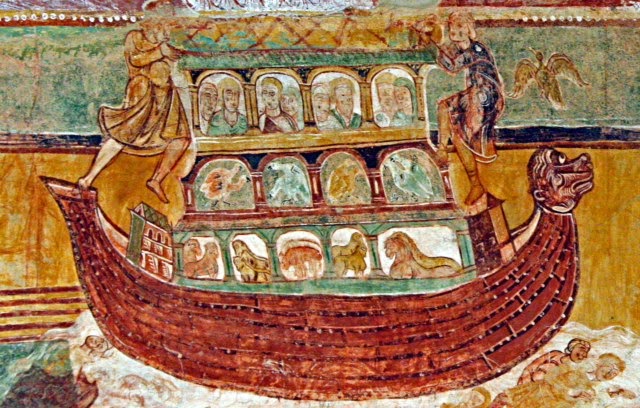
Venue: John Rylands Library, Deansgate
Non-Members are always welcome.
Thursday 23rd April 2015, 6pm
Noah’s Ark in the Earlier Middle Ages
Professor Brigitte Resl
Dean of Faculty of Arts and Social Sciences
University of Hull
Venue: John Rylands Library, Deansgate
Non-Members are always welcome.
Wednesday, 25 March 2015
MEDATS Spring Conference and AGM
Medieval Dress and Textiles Society
Saturday 30th May 2015
The Hall, The Art Workers’ Guild, 6 Queen Square, Bloomsbury, London WC1N 3AT
(Nearest tube Holborn or Russell Square. Buses: 59, 68, 168)
Occupational Dress
Programme
9.30 Registration
10.00 Welcome
10.15 David Rushworth: Fifteenth-Century Domestic Liveries
11.00 Tea/coffee. Opportunity to buy at the bookshop (cash/cheque only)
11.30 Dr Sven Hauschke: The “house books“ of the Nuremberg Twelve-Brothers-Foundation (1388-1806)
12.15 Dr Timothy Dawson: Law Enforcement Insignia and Uniforms in Constantinople, Tenth to Twelfth Centuries
1.00 Finger buffet lunch. Opportunity to buy at the bookshop (cash/cheque only)
1.45 Annual General Meeting (members of MEDATS only)
2.30 Dr Jane Malcolm-Davies and Ninya Mikhaila: “All my sea clothes”: Mariners’ Dress in the Sixteenth Century
3.15 Tea/coffee. Opportunity to buy at the bookshop (cash/cheque only)
3.45 Glynis Hughes: The Cryes of London: Clothes of London Tradespeople Depicted in the Earliest Series of Prints Held at the Pepys Library
4.15 Recap and discussion
4.30 End of meeting
Ticket Prices
Single member ticket - £25
Non-member ticket - £30
Student ticket - £15
Dual (1 member + 1 non-member
booked together) - £50
Ticket price includes refreshments and a light finger buffet lunch.
For more information, or to book tickets, please visit the MEDATS website.
Sunday, 15 March 2015
The Brook Lecture in Middle English
Thursday, 16 April, 5.30pm
Christie Seminar Room, John Rylands Library, Deansgate, Manchester
Professor Stephanie Trigg
(University of Melbourne)
Changing Faces: The Dynamics of Facial Expression and Emotion in Middle English Literature
The Brook Lecture, part of the English and American Studies seminar series, honours the memory of G.L. Brook, Professor of English Language and Medieval English Literature at Manchester University, 1945–77. We are pleased to welcome as this year’s speaker Stephanie Trigg. Professor Trigg is the author of Shame and Honour: A Vulgar History of the Order of the Garter (2012), Congenial Souls: Reading Chaucer from Medieval to Postmodern (2002), and many articles. She is one of the Program Leaders of the Australian Research Council-funded Centre of Excellence for the History of Emotions.
Enquiries: David Matthews
Wednesday, 29 October 2014
CFP: Telliing Tales: Manuscripts, Books and the Making of Narrative
The biennial conference of the Early Book Society 2015
The next biennial conference of the Early Book Society will take place at the University of Oxford, from lunchtime on Thursday 2 July 2015 to early afternoon on Sunday 5 July 2015. Abstracts of 300 words or fewer for 20-minute presentations should be sent to the organizers by 30 November 2014 to the conference e-mail address. Abstracts should include your name, affiliation (where relevant) and email address. Computers and data-projectors will be available for all sessions; speakers would need to bring presentations on a memory stick / USB plug-in device. People who have other AV needs should specify this on their abstract.
The theme, which may be interpreted narrowly or broadly, invites special attention to the material records of different genres of narrative, such as verse, romance, chronicle, biography or history. It might consider the ways that manuscripts, printed books and other media serve a narrative function: whether page layouts were modified for chronicles and annals, whether collections of documents were compiled to tell stories, whether images in books are important components of storytelling, whether poems on monuments recount lives.
The topic also invites participants to tell different kinds of stories about early books. In particular, we may reflect on our storytelling as scholars. What is the role of biography – of the author, of the ‘celebrity’ scribe, of the idiosyncratic reader – in the study of early books? How sure can we be of cause and effect, of chronology and dating, of different kinds of paleographical, codicological and bibliographical evidence, in studying these books? Are history and narrative the best models for ‘book history’ or might studies of manuscript and print serve literary criticism, linguistics or philology in other ways?
Finally, papers which concern books in or around Oxford are also encouraged. But, in general, proposals for papers on any aspect of the history of manuscripts and printed books from 1350 to 1550, including the copying and circulation of models and exemplars, style, illustration, and/or the influence of readers and patrons, artists, scribes, printers, are welcome.
Accommodation and most meals will be available at St Anne’s College, Oxford. Most lectures will take place there too, but part of the conference will take place in the newly renovated Weston Building of the Bodleian Library, which reopens officially in March 2015. There will be ‘masterclasses’ with manuscripts on show, a visit to the exhibition and some optional visits, on a first-come-first-served basis, ‘behind the scenes’ to departments of the library. We are grateful to the Centre for the Study of the Book in the Bodleian for co-hosting the conference and sponsoring these events.
The website with details of registration and accommodation will go live later this winter and will be announced on the EBS listserv, Facebook, and also on the EBS website.
For those making travel plans, there are some preliminary points to bear in mind.
Depending on availability, accommodation might be in St Anne’s or other Colleges for extra nights before or after the conference. Oxford is about an hour from central London by rail. The closest international airport is London Heathrow, and from there and from London Gatwick there is a convenient coach service, The Airline, which can be booked in advance. Birmingham International Airport is also close and has direct train connections to Oxford every half an hour.
People planning to combine the conference with a research trip might be reminded that the Special Collections department at the Bodleian Library and the Colleges’ libraries tend to be busy with visitors in the summer months, so planning is advised, given that dozens of early book enthusiasts will be in town!
Also, Leeds International Medieval Congress begins the day after our conference, on Monday 6 July 2015. Travel from Oxford to Leeds on Sunday evenings takes three and a half hours by rail, direct or with one change, and if booked far enough in advance (up to three months in advance) can cost (at this year’s rates) as little as £45.
Subscribe to:
Posts (Atom)