Tuesday, 19 February 2019

NEXT MEETING THURSDAY 21 FEBRUARY 2019


Thursday 21 February 2019, 6.00pm
Samuel Alexander Building, A116

Dr Anke Bernau (Senior Lecturer in Medieval Literature and Culture at the University of Manchester): Late Medieval Knots – Pain, Delight, Mystery’

Wednesday, 25 April 2018

Upcoming Event: Medieval Society and MANCASS Annual Joint Lecture


Michael Wood
'The Lady of the Mercians:
Æthelflæd (d. 918), Daughter of Alfred the Great'


Date: 3 May 2018
Time: 6:00pm
Venue: Samuel Alexander Lecture Theatre, University of Manchester


Join us for our annual joint lecture with the Manchester Centre for Anglo-Saxon Studies. This year, we're pleased to welcome historian and presenter Michael Wood, Professor of Public History at University of Manchester, who will be speaking on a timely topic. His talk is about 'The Lady of the Mercians: Æthelflæd (d. 918), Daughter of Alfred the Great,' as one of the first events this year on the millennial anniversary of her death.


Saturday, 25 November 2017

Upcoming Event: Professor Gale-Owen Crocker Christmas Lecture

'Deck the hall' Anglo-Saxon Style

Professor Emerita Gale Owen-Crocker (University of Manchester)


Date: Thursday 7 December 2017
Time: 6pm
Venue: Christie Room, John Rylands Library, Deansgate

Members - free; Non-members - £5 (waged)/£2 (unwaged)

Friday, 13 October 2017

Manchester Medieval Society Visit to Clayton Hall

Post written by Dr Anne Kirkham, Manchester Medieval Society President

Photo Credit: Hannah Priest

As Manchester Medieval Society’s incoming president, I was excited to join the first event of the academic year, a visit to Clayton Hall on Sunday 24 September. We gathered in a beautiful sunlit garden that covers much of the 74m by 66m site, surrounded by a continuous medieval moat (now dry and strikingly rectangular if you look at a plan of the site), which is accessed via a Grade II listed, seventeenth-century, coursed, squared sandstone bridge comprising two segmental arches, a central pier and a cutwater on each side.

Photo Credit: Hannah Priest

The land belonged to the Clayton family in the twelfth century. In 1194 the land and its hall passed into the ownership of the Byron family – of whom the poet, Lord Byron, is a descendant. Nothing is really known of the original structure, and details of the expansion and remodelling of buildings, including a chapel, in the fifteenth century survive only partially. But the sense of a great Tudor house is expressed in the timber panelling, casement windows, bell-cote and impressive chimney stack that form the right-hand portion of the surviving building. All this was pointed out to us by the lovely and knowledgeable volunteer Friends of Clayton Park without whom Clayton Hall would not be open to visitors – indeed, it may not have survived (its poor condition saw it at risk of demolition just a few years ago).

Photo Credit: Hannah Priest

Once inside, we went to the Humphrey Chetham room, so-named since it recalls that Clayton Hall was acquired and lived in by Humphrey Chetham (1580-1653), the Manchester cloth merchant who founded Chetham’s School and Library (about which Manchester Medieval Society members will learn lots more when we have the fortunate opportunity to visit the library on 28 February 2018).

In the Humphrey Chetham room, we learned something about his working life, and his royal and political encounters with Parliamentarians, including Thomas Fairfax, documented as staying at Clayton Hall during the English Civil War. The room is sympathetically decorated, with a picture of Fairfax on the wall. Most impressive for me was the timber framing that arched into the roof and, in the adjacent room, ingeniously a window has been put in the ceiling with spotlights in the roof space that allow you to study how the roof is constructed.

Photo Credit: Hannah Priest

Humphrey and his brother, George, had bought Clayton Hall in 1620 and it passed to George’s children in 1653, after which time records of ownership are a little sketchy – the volunteers have done an amazing amount of work to put together the story of Clayton Hall, but there is surely an archival research project or two here. In 1897 it was acquired by Manchester Corporation and was residentially tenanted until recently. One of the fascinating files put together for visitors is a memory book of photographs and recollections provided by families that lived in Clayton Hall in the twentieth century. Some of them must have been darts players – we were entertained with the story of how conservation fears over a pattern of small holes on a section of wall were allayed when someone worked out that the undamaged circular area in the middle of the holes was consistent with the placement of a dartboard on the wall!

Photo Credit: Hannah Priest

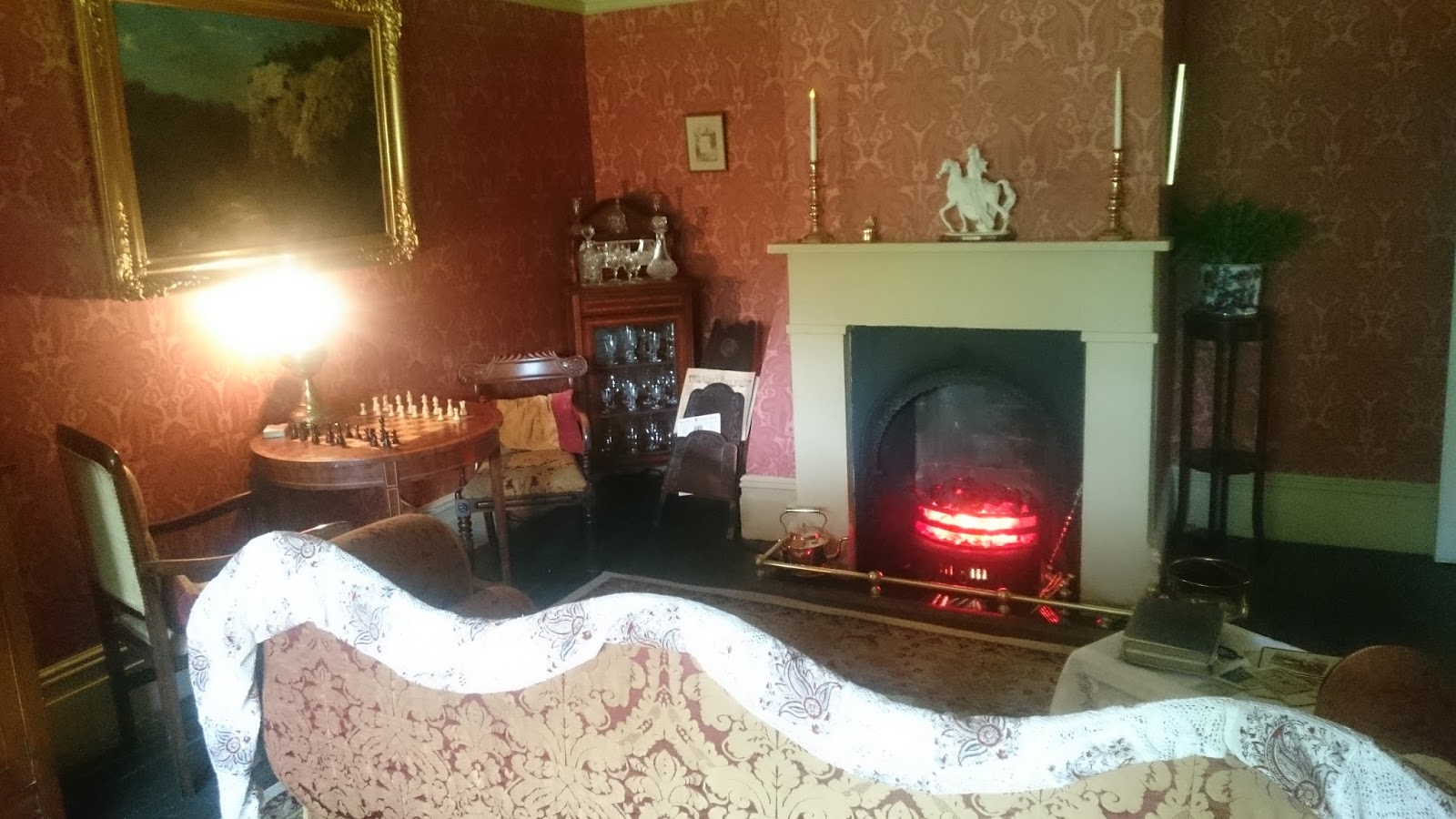
The other parts of the building exhibit changes made in the seventeenth, eighteenth and nineteenth centuries and, through the great practical efforts of the volunteers (see their planning, painting and plastering skills on their website), this part of the Hall has been presented as a Victorian home with visitors encouraged to dress up, play chess (one game lasted two hours) and to make ‘modelling putty mince’ using the mincer in the kitchen.

We all had a fabulous time. One of our party was Dr Catherine Casson and I am delighted that she will be our first speaker in the Society’s 2017-2018 programme. I look forward to welcoming you to her talk on 19 October.

Photo Credit: Hannah Priest

But for now, I just want to thank all the volunteers for their time and hospitality. Do look at their website and, if you missed our visit, do find an Open Saturday when Clayton Hall (the metro stop to which it gives its name is just outside) will be able to welcome and delight you too.

Photo Credit: Hannah Priest

Friday, 6 October 2017

Upcoming Event: Dr Catherine Casson

Gloucester rental of 1455
Speculation, Compassion and Capitalism: Insights from Medieval English Real Estate Markets
Dr Catherine Casson (University of Manchester)

Date: Thursday 19 October 2017
Time: 6pm
Venue: Roscoe 4.2, University of Manchester, Brunswick Street (off Oxford Road)
Attendance: Members - free; Non-members - £5 (waged)/£2 (unwaged)

There will be a dinner with the speaker following this talk. If you would like to attend, please email our treasurer Dr Hannah Priest to book a place.

Monday, 19 June 2017

Guest Post: The Rich and Strange: Women Working Sea-Changes in Chaucer’s Man of Law’s Tale

by Dr Daisy Black (University Of Wolverhampton)

‘Diverse men diverse thynges seyden.’ (The Man of Law’s Tale, l. 211)
‘All of us know that I can’t tell a tale of days long ago that Chaucer hasn’t already told. If he hasn’t said them in one book, he has said them in another.’ (Broken Shells)
Stories hold a political power that can even surprise their tellers.

The Man of Law. San Marino, CA, Huntington Library, EL 26.C.9, Ellesmere MS, fol. 50v. http://www.digital-scriptorium.org

In Chaucer’s Man of Law’s Tale, a group of Syrian merchants return home with a story of a Roman woman, Custance. She has beauty without pride; youth without foolishness; and humility without tyranny.

On hearing this story, the Sultan of Syria declares he will die unless he have Custance as his wife. To make this happen, he decrees he and his people will forsake the laws of Mohammed, and convert to Custance’s religion – Christianity. This decision causes great division. The Sultan’s advisors are flung into heated debate – about conversion, the foreign, and the ‘other’. ‘Diverse men’, Chaucer tells us, ‘say diverse things’.

And in this way, a story traded by men merely hoping to win favour with their ruler escalates into a massacre.

I was commissioned to devise Broken Shells – a one-woman storytelling performance of Chaucer’s Tale – for the 2016 symposium ‘Women at Sea’ at Swansea’s National Waterfront Museum. The Man of Law’s Tale is the sole text appearing in the second fragment of The Canterbury Tales as ordered in the Ellesmere manuscript (c. 1400-1410). The tale reworks the ‘princess/virgin at sea’ narratives of popular contemporary hagiography and romance together with the trope of the accused queen. In many ways, Chaucer’s heroine Custance is the ultimate ‘woman at sea’, as she has the bad fortune to be repeatedly placed in a rudderless boat and set adrift.

I knew as I began adapting this story for a modern audience, that Chaucer’s story would accrue loaded political connotations. My adaptation was told at the end of a long year filled with distressing reports of the plight of refugees in the Mediterranean, Syria, Greece, Turkey and at Calais. These reports simultaneously formed the daily horror stories of the news channels, yet were repeatedly erased in political discourse through ever-more virulent anti-immigrant dialogue of the Brexit campaign.

I knew my story would be performed at the end of a day of a symposium which had been opened by a roundtable panel of writers – all of whom were refugee women now living in Swansea. These women shared stories and poems about their experiences of being dislocated from their homes and former lives and forced to seek asylum in a new land. In telling Chaucer’s tale, I wanted to honour these women, but not eclipse their own stories.

As it happened, the story took on a meaning I could never have predicted. It was performed only a few days after the Brexit vote, right at the end of that uneasy week in which established political figureheads crumbled, the pound plummeted and, for many, the very values of what it meant to be ‘British’ had been caught in a tidal wave of confusion. As a result, Broken Shells, along with the academic papers of several colleagues, took on an urgency and painful directness that it had not had during my months of rehearsal.

More importantly, when juxtaposed with the personal narratives of real ‘women at sea’, the heroine of my, and Chaucer’s story, emerged in a rather different light to the heroine I thought I had lived with through rehearsals. By the afternoon telling, my vision of Custance as a brave, but essentially passive victim of prejudice had entirely dissolved. She became an indomitable woman whose strength lay, not in passivity, but in survival. This reassessment of survival and strength also opened up more sympathetic ways of reading some of the other women in the Man of Law’s Tale – in particular, Custance’s female antagonists, who consciously use storytelling to manipulate both the men around them and the political climate.

In that opening performance of Broken Shells, the female characters’ desire to tell, or to refuse to tell, their stories, had become a political action.


Surviving the Story

‘What she was she wolde no many seye, For foul ne fair, thogh that she sholde deye.’ (ll. 524-5)
In The Man of Law’s Tale, the narratives around Custance are primarily constructed by, and for, men. Custance first enters the story as a figure constructed entirely by narrative, masculine ideals and misogynist hyperbole. In many ways, the Syrian merchants’ stories construct Custance, not as extraordinary, but as the utterly commonplace, familiar heroine of medieval romance: the ideal woman. As such, they tell us absolutely nothing about Custance as a character.

The merchants’ report is part of a storytelling economy in which tales are exchanged as part of the trading process, or used as currency to gain favour with political leaders. The men who become Custance’s husbands – the Sultan of Syria and, later, King Alla of Northumbria – are primary receivers of stories about Custance, and yet they know very little about her. The Sultan is an idealist: like an avid consumer of today’s ‘fake news’, he takes all stories as the truth and makes decisions based on them. King Alla attempts to be a more critical reader. Yet while he demonstrates a healthy scepticism of the narratives told about and against Custance, he nevertheless bases his decisions on narratives told about a silent woman.

As the story progresses, Custance continues to be presented as a surface against which men project their own stories. This storytelling is often violent. A Northumbrian knight tries to frame Custance for the murder of her host and friend, Hermengyld. He almost succeeds even though many others swear that Custance loved Hermengyld ‘right as her lyf’ (l. 625). A castle steward boards Custance’s stranded ship in the middle of the night, subverting the chivalric romance form when he tells her he will be her lover ‘wherso she wolde or nolde’ (l. 917).

Literary criticism dealing with Custance has, until recently, examined her, either as the sum of the stories told about her or as a relentlessly unchanging entity – even though her presence demands change of all those she encounters. Yet translating Custance’s narrative into a story crafted for modern audiences, I noticed that none of these stories ‘stick’. While male acts of storytelling in The Man of Law’s Tale aim to change Custance – through marriage, murder or rape – the roles these stories cast her in never last. Whenever Custance is set adrift, her voyage erases these projected identities – of wife, murderer, lover and victim. Whenever she arrives in a new land, she never tells those she encounters her name, who she is, or her status. In maintaining her silence, Custance makes the male storyteller impotent.

Storytelling in The Man of Law’s Tale often causes religious and political strife, miscarriages of justice, false accusations, and it facilitates violence against the female body. However, Custance’s refusal to tell her own stories disrupts this masculine story-economy. Her denial of the role of storyteller keeps her identity apart from those seeking to define her, and allows her to survive.

Stories as Cultural Past 


While Custance uses silence to control her identity in diverse societies determined to project identity upon her, two of the tale’s antagonists – the Sultan’s mother and Donegild, mother of King Alla, seek to wield narrative to their own political advantage.

Chaucer presents both of Custance’s mothers-in-law as uncomplicatedly, thoroughly evil. He calls the Sultan’s mother a ‘cursed krone’ (l. 433) and Donegild is ‘ful of tirannye’:
‘The kynges mooder ful of tirannye. Hir thought hir cursed herte brast atwo […] Hir thoghte a despit that he sholde take So straunge a creature unto his make.’ (ll. 696-700)
The malicious mother-in-law was often used in medieval literature to exemplify a fear of supersession or transition. Christine M. Rose has argued that the mother-in-laws’ fear of change in The Man of Law’s Tale might be linked to an anti-Semitic Christian polemic which figured Judaism as hostile, yet necessary prior: a representative of the Old Law is supplanted by a New Law as the mother is supplanted by her son’s bride.(1) The narrative of supersession – the replacement of one law by another – was central to medieval Christian theology, and appears in many different guises, from artwork juxtaposing Eve and the Virgin Mary to the spectacular performances of pagan conversion to Christianity in the late fifteenth-century Digby Mary Magdalen play. In performing her generic role as the prior ‘other’, the Sultan’s mother therefore objects to her son’s abandonment of their holy laws:
‘But oon avow to grete God I heete: They lyf shal rather out of my body sterte Than Makometes lawe out of my herte!’ (ll. 224-6)
She successfully takes steps to prevent the mass conversion she fears by slaughtering her son and his supporters at the wedding feast, and sending Custance to sea in a rudderless ship. While constancy in Custance is lauded by Chaucer’s poem, constancy to a non-Christian religious law is condemned.

The Sultan’s mother and Donegild caused me a number of challenges in devising Broken Shells – not least, in my need to deal sensitively with the story’s portrayal of Christianity and its anti-Islamic elements yet remain true to Chaucer’s original story.

This process was made a little easier by the fact that, despite Chaucer’s attempt to cast both the Sultan’s mother and Donegild as unproblematic, ‘evil’ characters set in opposition to the Christian Romans (a Muslim and a pagan, respectively), both nevertheless perform one of the key roles ascribed to early medieval English women.

Elisabeth van Houts has argued that early medieval women performed a central role in the preservation of community memory: ‘women were crucial links in the chain of traditions binding one generation to another’.(2) The female promotion of social and familial memory became particularly important after traumatic historical changes (for example, in maintaining historical rights to land post-invasion). It also performed more subversive functions – for example, when Anglo-Saxon women preserved their pre-conquest traditions for several generations after the Norman Conquest by giving their daughters Anglo-Saxon names. Where these kinds of memory are ‘approved’ by a new regime, the woman’s role, or constancy, is lauded. Custance’s retention of her Christian faith through all trials is therefore what makes her the heroine of Chaucer’s story. However, when a woman’s cultural memory works against, or threatens a new regime, it is too often cast as unruly, or divergent.

The Sultan’s mother as I have characterised her in Broken Shells is therefore very much aware of her own intertextual nature. As a Syrian woman, she has grown up hearing the stories of Troy, and the ashes of that city cling to her adult soul:
‘a shrewd survivor of state politics, and knows all too well what happens when a bride is plucked from a distant land’ (Broken Shells)
The cultural currency this kind of collective narrative is fully exploited by Chaucer’s Man of Law, who lists Ovid’s classical, cross-national lovers – Dido, Helen and Ariadne – in the introduction to his tale. The Sultan’s mother – and Donegild’s – resistance to a new narrative being superimposed over their own therefore ties into their roles as both keepers of cultural memory and as creative readers.

Stories as Weapons 


Custance’s second mother-in-law is similarly associated with regression. Even her name provides a subtle echo of the word Danegeld: the tax the Anglo-Saxons were obliged to pay the Vikings in the years after they lost the Battle of Maldon (991). As such, Donegild’s character is shaped by the memory of economic coercion and the ongoing war her son, King Alla, is embroiled in. But while the Sultan’s mother is associated with the past by acting as both repository and retainer of cultural and religious memory, Donegild seeks to maintain constancy through becoming a storyteller.

While Alla is absent, Custance gives birth to their son. Donegild intercepts a letter informing her son of the birth, and sends a counterfeited letter in its place. This letter tells her son that Custance is an elf, and has given birth to ‘so horrible a feendly creature’ (ll. 751) none in the castle dare stay in the room with it. Donegild’s letter self-consciously taps into medieval medical writings about women giving birth to monsters.(3) It also equates Custance’s ‘straungeness’ with monstrosity. In doing so, Donegild enters the masculine economy of storytelling in an attempt to get rid of her rival.

While the Sultan, and to some extent, King Alla, are passive receivers, the Sultan’s mother and Donegild are producers, retainers and manipulators of stories. They are fully aware of the political power of the story, and they use this power to direct their own narratives. In doing so, the Sultan’s mother and Donegild challenge the tale’s underling value of constancy. Like Custance, these two female antagonists remain constant to their own pasts. Yet this constancy also prevents them from accepting the foreign, and the new. Ultimately, it also prevents them adapting, as Custance does, in order to survive.

Stories as Cities

‘Joye of this world, for tyme wol nat abyde Fro day to nyght it changeth as the tyde.’ (ll. 1133-4)
Almost a year after the first performance, I’m preparing to tell this tale once again as part of the University of Manchester’s Middle Ages in the Modern World (MAMO) conference. Revising this story after a divisive and inconclusive election campaign, and where news of the refugee crisis has been almost entirely dropped by the mainstream press, I am finding different pressures being brought to bear on Chaucer’s narrative. On the 30th of June, this story will be told in front of the medieval rood screen in Manchester Cathedral – a building that was ransacked during the civil war in 1649, hosted Thomas Clarkson’s famous speech against the slave trade in 1787 and which still bears the scars of the 1940 blitz. It will be told in a city where violence has been so recently seared into the memories of many in my audience. As I rehearse, piles of flowers and toys are being cleared from St Ann’s Square. Manchester remembers violence aimed at the city as a whole, but, more specifically, aimed at its young girls and women.

Yet stories hold political powers that can even surprise their tellers.

Modern popular culture relentlessly depicts its heroes as story-makers – (frequently) male, rebellious, impetuous, and often violent. But Chaucer’s Custance offers a very different model of what it is to be strong. Violence and cultural fear are repeatedly directed towards Custance again and again – through military action, murder, exile and rape. Yet Custance refuses to take part in this narrative cycle by repeating these stories. Rather, she demonstrates the strength it takes to survive – again, and again, and again.

Broken Shells will be performed at Manchester Cathedral at 5.30pm on the 30th June. It is a free event, but donations raised will go to Sheffield Donations for Refugees and the Booth Centre. Click here to book tickets.

Notes

(1) Christine M. Rose, ‘The Jewish Mother-in-Law: Synagoga and the Man of Law’s Tale’, in Sheila Delany (ed.), Chaucer and the Jews: Sources, Contexts, Meanings (London: Routledge, 2002), pp. 3-23

(2) Elisabeth van Houts, Memory and Gender in Medieval Europe 900-1200 (Toronto, ON: University of Toronto Press Inc, 1999), p. 147

(3) See Dana Oswald, Monsters, Gender and Sexuality in Medieval English Literature (Woodbridge: D.S. Brewer, 2010), pp. 1-26

Further Reading

Christine M. Rose, ‘The Jewish Mother-in-Law: Synagoga and the Man of Law’s Tale, in Sheila Delany (ed.), Chaucer and the Jews: Sources, Contexts, Meanings (London: Routledge, 2002), pp. 3-23; Elisabeth van Houts, Memory and Gender in Medieval Europe 900-1200 (Toronto, ON: University of Toronto Press Inc, 1999); Dana Oswald, Monsters, Gender and Sexuality in Medieval English Literature (Woodbridge: D.S. Brewer, 2010): Robert B. Dawson, ‘Custance in Context: Rethinking the Protagonist of the “Man of Law’s Tale”’, The Chaucer Review 26:3 (1992), 293-308; Melissa M. Furrow, ‘The Man of Law’s St Custance: Sex and the Saeculum’, The Chaucer Review, 24:3 (1990), 223-235; Laurel L. Hendrix, ‘“Pennannce profytable”: The Currency of Custance in Chaucer’s Man of Law’s Tale’, Exemplaria 6:1 (1994), 141-166

About the Author

Dr Daisy Black is a lecturer in English Literature at the University of Wolverhampton. She specialises in medieval religious drama, with a particular interest in time and gender and food in performance. Recent works include articles on the hortus conclusus in Cornish religious drama, on the nails used to crucify Christ in the York ‘Crucifixion’ pageant, and on domestic arguments between Mary and Joseph in the N-Town plays. She also works as a freelance storyteller, theatre director, arts advisor and writer, and has produced creative work for bodies including the Royal College of Physicians, Manchester Cathedral and Swansea’s National Waterfront Museum. Broken Shells was her first one-woman show, and she is currently working on her next major storytelling project, The Bayeux Tapestry: The Full Yarn.

Thursday, 20 April 2017

Upcoming Event: Professor Andrew Breeze Lecture


The Northern Arthur and the Volcanic Winter of 536-37
Professor Andrew Breeze (University of Navarra)

Joint meeting of Manchester Medieval Society and the Manchester Centre for Anglo Saxon Studies (MANCASS). Non-members welcome.

Date: Thursday 27 April 2017
Time: 6 p.m.
Venue: John Rylands Library, Deansgate, Manchester
Attendance: Free

There will be a dinner with the speaker following this talk. If you would like to attend, please email our treasurer Dr Hannah Priest to book a place.

Sunday, 5 March 2017

New Seminar Series: Connecting 'Medieval' Worlds

A new medieval history and archaeology series, organized by University of Manchester students.


2017 Programme

16th March, 5-7pm: 'Rethinking the Urban Revolution in World History', Conrad Leyser (University of Oxford)
Room 4.211, University Place

30th March, 5-7pm: 'Options and Experiments: Defining the "Global Middle Ages"', Naomi Standen (University of Birmingham)
Room 4.211, University Place

18th May, 5-7pm: 'Wheat, Arms, and Secrets - Carlo II Toco and the Republic of Ragusa', Robin Shields (Royal Holloway); 'Declassifying Trade Systems in an International Era', Adam Simmons (University of Lancaster)
Room G006, Renold Building

15th June, 5.30-7.30pm: 'Sharing Spaces, Sharing Symbols: The Creation of Inbetween Identities in Moments of First Encounter in the New World', Claudia Rogers (University of Leeds); 'Ritual and Economy: Thinking Through a 12th C. Shrine from Northern Ghana', Holly Atkinson (University of Manchester)
Conference Room, The Graduate School, Ellen Wilkinson Building

Refreshments provided. All welcome. For more information, please email the seminar convenors.

Friday, 10 February 2017

Upcoming Event: Hic Dragones Book Launch

Event information from Hic Dragones...

Into the Woods Launch Party


Come and join us at the launch party for Into the Woods, a new collection of short stories from Hic Dragones.

Friday 17th March 2017, 7-9pm
International Anthony Burgess Foundation
3 Cambridge Street
Manchester M1
United Kingdom

FREE EVENT

Into the Woods - eighteen sinister sylvan tales

A magical place steeped in mysticism. A foreboding place of unspeakable terror. The forest is a place of secrets, a place of knowledge, a place of death, and a place of life. What resides within its shadows? Demons, fair folk, that man the adults warned you about… and the trees. The trees are everywhere. Is it safer to stay at home? Or are you ready to take a journey… into the woods.

“They were only trees, after all. Only trees.”


Join us at the launch party on Friday 17th March. Readings by: Ramsey Campbell, Tracy Fahey, Jane Bradley, Magda Knight, Martin Cornwell, Hannah Kate, Megan Taylor and Nancy Schumann

Free wine reception, giveaways and launch discount on the book.

Upcoming Event: JRRI Medieval and Early Modern Research Seminar Series

Event information from the John Rylands Research Institute...

 Quantifying Caxton – Taking a Digital Approach to Historical Spelling Variation


Rosie Shute (University of Sheffield)
Thursday 9 March, 5.30pm
Christie Room, John Rylands Library Deansgate

‘Logic, Rhetoric, Arithmetic’ in Myrrour of the Worlde (Westminster: William Caxton, 1480)
Rylands 3469, c4v-c5r ©The University of Manchester

William Caxton (c. 1422-91) began printing in England in 1476, publishing over one hundred texts throughout his lifetime. We tend to think that Caxton's texts represent Caxton's language; however this talk demonstrates the influence of the type-setter on the language of Caxton's printed work, focusing on spelling in particular and drawing on methods from mathematics, computer science, and the history of the book.

Free event. All welcome.

Monday, 6 February 2017

Upcoming Event: Manchester Cathedral Tour and Talk (Booking Required)

Manchester Cathedral and the Making of a Medieval Town – an Archaeological-Architectural Tour

Dr Andy Hardman (Heritage Officer, Manchester Cathedral)

By Rept0n1x (Liverpool & Manchester (295)) [CC BY-SA 2.0], via Wikimedia Commons

Wednesday 15th February 2017, 6pm
Manchester Cathedral Visitor Centre, 10 Cateaton Street, Manchester, M3 1SQ

Places are limited, so booking is required for this event. Members (free attendance): please email Hannah Priest to RSVP. Non-members (attendance £5 (waged)/£2 (unwaged): please register online here:


Attendance

Wednesday, 23 November 2016

Upcoming Event: Anne Kirkham Lecture on 8 December

Detail from the title page in a printed Dutch Book of Hours (Antwerp: Adrien van Liesvelt, 1494)
John Rylands Library Special Collections 15464 © The University of Manchester

Hark the Herald… Angels in the John Rylands Library’s Books of Hours


A lecture for Manchester Medieval Society by Dr Anne Kirkham (Art History and Visual Studies, The University of Manchester)

Date: 8 December 2016
Time: 6 p.m.
Venue: John Rylands Library, Deansgate, Manchester
Attendance: Members - free; Non-members - £5 (waged)/£2 (unwaged)

There will be a dinner with the speaker following this talk. If you would like to attend, please email our treasurer Dr Hannah Priest to book a place.

Sunday, 9 October 2016

Manchester Dress and Textile Discussion Group Programme 2016-17

All meetings are 5-6pm, and are held in Seminar Room 1, The Graduate Suite, Ellen Wilkinson Building, unless otherwise stated.

Friday 18th Nov 2016: Charles Farris (Westminster): The Administration of Cloth and Clothing in the Great Wardrobe of Edward I

Thursday 23rd Feb 2017: Julie Wertz (Glasgow): The art and science of Turkey red dyeing in 19th-century Scotland

Thursday 30th Mar 2017: Maureen Carroll (Sheffield): Cultural and Ethnic Identities in Dress Behaviour in Roman Germany

Thursday 20th Apr 2017: Elizabeth Coatsworth (MMU): Clothing the Past: Circumstances in which Medieval Garments Survive
For more information, please contact Alexandra Lester-Makin or Ursula Rothe

Saturday, 1 October 2016

Upcoming Event: Kathryn M Rudy Lecture on 20 October

The Hague, KB, Ms 75 G 2, fol. 64v-65r: a very dirty manuscript

The Dirt and the Book: How Signs of Wear Reveal Handling of Prayer Books in the Middle Ages

with hands-on element

A lecture for Manchester Medieval Society by Dr Kathryn M. Rudy (Senior Lecturer in Art History, University of St Andrews)

Date: 20 October 2016
Time: 6 p.m.
Venue: John Rylands Library, Deansgate, Manchester
Attendance: Members - free; Non-members - £5 (waged)/£2 (unwaged)

Monday, 23 May 2016

Manchester Medieval Society Excursion 2016

Post written by Joanna Robertson, MA student (University of Manchester)

This year’s annual Medieval Society excursion was on Saturday 14th May, and we travelled to North East Wales. And Wales welcomed its Manchester visitors with bright sunshine!

Flint Castle

Flint Castle. Photo credit: Hannah Priest

The first site was Flint Castle, standing above the saltmarsh and mudflats, along the River Dee, with the Wirral as a backdrop. This strategic position, west of Chester, was where Edward I built his first castle, to support his campaign against the Welsh. Begun in 1277, under the supervision of James of St George, building work continued into the 14th century. Shakespeare reminds us that Richard II gave himself up to Henry Bolingbroke at Flint Castle, after he left the security of another castle at Conwy. Flint Castle is moated, has an outer ward, three circular towers and a free-standing great tower or donjohn. The building stone used was millstone grit ashlar and sandstone and was re-used locally, when parliamentary forces ordered the dismantling of the castle. The adjacent town of Flint was laid out in a grid pattern, still visible as one looks down Church Street.

Flint Castle. Photo credit: Hannah Priest

Flint Castle. Photo credit: Hannah Priest

Maen Achwyfan

Maen Achwyfan Cross. Photo credit: Joanna Robertson

The next visit was to a much smaller stone structure, yet Britain’s tallest wheelcross, at Maen Achwyfan. It stands in a grass field, inside a fenced enclosure. As it is on the North Wales Pilgrim Trail, a small hidden box contains a stamp for one’s passport! This is a tall, carved stone cross, dated to the 10th or 11th century. The intricate patterns reflect both Viking and Celtic influences and its purpose is still the subject of speculation. It could be a ‘lamentation’ cross or a boundary marker for the Basingwerk Abbey lands.

Maen Achwyfan Cross. Photo credit: Hannah Priest

St Winefride’s Well

Our climb up from the coast and towards Holywell afforded excellent views over the Dee Estuary, now far less navigable than during the medieval period. The town of Holywell, associated with the nearby shrine of St Winefride, was our lunch stop. It has a wide high street, with a weekly market, a right granted to the monks of Basingwerk Abbey. Its many fine Georgian frontages indicate the wealth derived from the industrial past of the Greenfield Valley.

St Winefride's Well. Photo credit: Hannah Priest

A short walk down the valley side brought us to the entrance to St Winefride’s shrine, still a place of pilgrimage with associated interpretation. Committee member Maureen Mulholland introduced us to Winefride, her rapacious suitor, his beheading her, a gush of water from the spot where her head fell and the restorative powers of her uncle Beuno! The well has been a pilgrimage destination since the 7th century, with visits from royalty. The last monarch to visit was James II, who prayed for a son (although Princess Victoria also visited with her uncle King Leopold of Belgium). The visitor centre is decorated with information panels and discarded crutches from people miraculously cured, having bathed in the waters of the spring. A chapel was built in about 1500, probably for Margaret Beaufort, around three sides of the well and further buildings have been added to the site. Nobody in our party bathed in the large pool but some filled their water bottles from the ‘holy’ tap!

St Winefride's Well. Photo credit: Joanna Robertson

St Winefride's Well. Photo credit: Hannah Priest

St Winefride's Well. Photo credit: Hannah Priest

Basingwerk Abbey

Basingwerk Abbey. Photo credit: Hannah Priest

Our final destination was the Abbey at Basingwerk. I briefly introduced its history to the group, as I’ve recently completed some research on the site for an MA essay. Founded as a Savigniac house by the powerful baron Ranulf of Chester, it received gifts from both Anglo-Normans and the Welsh. It was richly endowed with lands and assets on the Wirral, in Derbyshire and from across the Kingdom of Gwynedd. The Cistercian style layout is still visible in a tranquil wooded setting. And the nearby Café at the Abbey was a welcome last stop!

Basingwerk Abbey. Photo credit: Hannah Priest

Basingwerk Abbey. Photo credit: Hannah Priest

Wednesday, 6 April 2016

Upcoming Events: Duncan Sayer Lecture on 14 April


Adventus Saxonum: Migration, DNA and Identity in the Early Middle Ages
2016 Joint Meeting of the Manchester Medieval Society and the Manchester Centre for Anglo Saxon Studies

Speaker: Dr Duncan Sayer (Reader in Archaeology, University of Central Lancashire)
Date: Thursday 14 April
Time: 6pm
Venue: John Rylands Library, Deansgate, Manchester

Attendance: Free

For more information, please contact the Manchester Medieval Society

Sunday, 20 March 2016

Craft in Medieval and Early Modern England

John Rylands Library, Deansgate
2 June 2016

This one-day conference will consider different ways in which the term ‘craft’ helps us to think through and articulate our approach to the medieval and early modern sources (in a range of media) that we work with. These, in turn, help us to think about the diverse possible manifestations and significations of the term ‘craft’ in premodern culture.

Keynote speakers:

Catherine E. Karkov (Leeds): ‘The Craft of Concealment’

Sarah Salih (King’s College, London): ‘Wondrous Pagan Crafts’

Speakers (University of Manchester):

Anke Bernau: ‘The Artificial Curiosity of Craft’
Catherine Casson: ‘Crafting Reputation: Strategies for Economic Success in English Medieval Towns’
Irene O’Daly: ‘Crafting Prayer: Rylands Latin MS 18 (Arbor Caritatis et Misericordiae) and the Art of Salvation’
James Paz: ‘The Craft of Wayland the Smith: Technology and Magic, Artifice and Deception’
Elaine Tierney: ‘Crafting the Ephemeral City: Sheds in Early Modern London’

Registration will open March 1st, 2016.

The programme will run between 10am-5pm.

Cost for the day:
(1) Including lunch: £15 / £10 concessions
(2) Excluding lunch: £10 / £5 concessions

For further information, contact either Dr Anke Bernau or Dr James Paz, or visit the event webpage.

Wednesday, 24 February 2016

Manchester Centre for Anglo-Saxon Studies: Toller Lecture 2016

Women Write the Past – Old English, New Literature and the Romance of Scholarship
Professor Clare Lees (King’s College London)


Mary Bateson (1865-1905)


Monday, 7th March, 6pm
Historic Reading Room, John Rylands Library, Deansgate

Followed by a free wine reception.
Further details, please contact Dr Charles Insley, Department of History, or Dr James Paz, Department of English.

Friday, 29 January 2016

Upcoming Event: Professor Paul Fouracre Lecture on 18 February

Satellite imagery of Saint-Wandrille-Rançon, Google Earth


Taming the Wild, and Wilding the Tame: Town and Country in Early Frankish Hagiography

Speaker: Prof. Paul Fouracre, Professor of Medieval History (University of Manchester)
Date: 18 February 2016
Time: 6p.m
Venue: Samuel Alexander A112, University of Manchester

Attendance: Members - Free; Non-members - £5 (waged), £2 (student/unwaged)

Please note: there will be a brief AGM before this lecture. For more information, please contact Georg Christ (Secretary).

Tuesday, 1 December 2015

Guest Post: Magic, Witches and Devils in the Persian Book of Kings

by Dr Stephen Gordon

Belief in devils and witches was a central feature of the medieval and early modern worlds. From Ars Moriendi texts that taught the dying how to avoid the clutches of the devil, to treatises on the machinations of witches, interactions with malign, evil entities were an accepted − if unwelcome − part of everyday life. While much has been written on the Occidental traditions of supernatural belief, it should also be noted that the Islamic world shared the same concerns about the agency of evil spirits. The epic Persian poem, the Shahnama, or ‘Book of Kings’, contained numerous stories involving magic, witches and demons. The historic John Rylands Library in Manchester is home to a fine selection of meticulously illustrated copies of the text.

Written between c.982−1010 CE by Abu’l Qasim Firdousi of Tus (‘Ferdowsi’, d. 1025CE), who took over the project from Abu Mansur Daqiqi (d. 976CE), the Shahnama charts the history of the Persian people from the beginning of the world to the fall of the Sasanian Empire (642CE). As well as being the longest poem ever written by a single author, the Shahnama is notable for the purity of its written Persian, with very few Arabic loan words included in the text. Structurally, it is divided into three main parts, the mythical, legendary, and historical eras, and covers the reigns of forty-seven kings and three queens. Almost two-thirds of the text is devoted to the legendary section of Iranian history, of which the adventures of the hero Rustam (see below) are given particular prominence. The Shahnama places great emphasis on the differences between good and bad kingship, providing moral lessons to entertain and edify its noble readership. Demons and witches – that is, evil incarnate – provided the ideal obstacles for ‘good’ kings and heroes to overcome. The increased commercialisation of manuscript production in the fifteenth and sixteenth centuries, focused mainly on the city of Shiraz, meant that the Ferdowsi’s masterpiece began to enjoy a much wider circulation, able to be read, copied and patronised by royal and non-royal audiences alike.

The storming of the castle of Bahman is one of the most visceral supernatural encounters recorded in the Shahnama. Following a long and eventful reign, the Shah Kay Kavus decided to abdicate his throne, but could not decide whether his successor should be his son, Fariburz, or grandson, Kay Khusraw. Thus he announced that whoever vanquished the demon-filled castle of Bahman would become the new ruler. Fariburz’s assault failed after the ground surrounding the castle magically burst into flames, forcing him to retreat. When Kay Khusraw approached the castle, he commanded one of his retainers, Giv, to attach a letter to the walls proclaiming the castle would fall to the rightful king. Almost immediately the ramparts began to crumble. Kay Khusraw wasted no time in ordering his archers to fire, killing many ‘Divs’ (demons) in the process. Those that weren’t killed in the initial onslaught died after falling from the battlements. Kay Khusraw returned home in triumph and accepted the Persian crown. This page from Persian MS 910, written in 1518 but not illustrated until much later, showcases the aftermath of the collapse of Bahman’s walls (fig. 1).

Fig. 1: The demon castle of Bahman, Persian MS 910, fol. 139a (c. 1518) (copyright of the University of Manchester)

Rustam is considered the greatest of the Shahnama’s heroic characters. In the tradition of other such legendary heroes as Herekles, Cu Chulainn and Beowulf, Rustam was a larger-than-life figure who, from an early age, performed many feats of strength, daring and courage. His most famous quest concerns the seven labours, or ‘courses’, undertaken to rescue the previously-mentioned Shah, Kay Kavus. Having been persuaded by a div disguised as a minstrel to invade the realm of Mazandaran on the Caspian Sea, the Shah and his army were captured and blinded by the infamous White Div (div-i safid), who had come to the aid of Mazandaran’s king. On hearing of the Shah’s predicament, Rustam determined to slay the Div, the blood from whose liver was the only substance that could restore the Shah and the army’s sight. In sequence, Rustam’s challenges included fighting a lion, finding a spring in the desert, defeating a dragon, a witch, the hero Ulad, the demon Arzhang and, finally, the White Div himself.

The fourth labour, the slaying of an evil witch, provides a fascinating insight into Persian conceptions of ‘good’ and ‘bad’ magic. Following his defeat of the desert-dwelling dragon, Rustam entered a valley populated by ‘sorcerers’ and came across a banquet that had been set up beside a stream. Noting that it was a “sorcerers’ meal” and that the participating divs had fled at the sound of his approach, Rustam sat down, picked up a lute and began to sing. His melodies reached the ears of a nearby witch, who approached Rustam in the guise of a beautiful young woman. Not knowing that she was a witch, Rustam offered her a glass of wine, invoking the grace of God as he did so. The witch recoiled at the mention of God’s name, an insult that prompted Rustam to ensnare her in his magical lasso. Ordered to “speak and show thy proper favour”, the witch transformed back into a hideous, wrinkled old hag. Rustam promptly stabbed her with his sword before continuing with his journey. While this illustration from Persian MS 9, produced in India, does not depict Rustam’s lasso, nor the witch’s hideous appearance, it clearly shows the moment when he is about to behead his adversary (fig. 2).

Fig. 2: Rustam and the Witch, Persian MS 9, fol. 78a (c. 1450s) (copyright of the University of Manchester). An inscription at the beginning of the manuscript states that it was once part of the collection of Sir Gore Ouseley (d.1844), the British diplomat who helped broker the Treaty of Golestan between the Persian and Russian Empires in 1813

Rustam’s quest ended when he arrived at the White Div’s underground lair, the setting of the seventh and final labour. Entering the pitch-black cave and finding the demon asleep, he roused his opponent with a fierce roar and cut off the Div’s hand and foot before he had time to react. Following a brief but violent struggle, Rustam killed the Div by throwing him upon the ground, after which he removed the demon’s liver. As expected, the blood from the liver magically cured Kay Kavus and his army of their blindness. This illustration from Persian MS 932 shows Rustam stabbing the White Div’s torso after having already sliced off its limbs (fig. 3). The animated, violent nature of the scene suggests that the Div has not yet been killed. This, then, is the middle of the fight rather than its aftermath. The image itself is defined by the contrast between the frenetic action occurring within the cave and the consternation of the human and demonic characters without. The figure at the very right of the page can be identified as Ulad, who was captured by Rustam during the fifth labour and made to act as his guide through the lands of Mazandaran. Rustam tied Ulad to a tree before entering the White Div’s cave. The horse at the lower right side of the page is Rustan’s faithful steed, Rakhsh.

Fig. 3: Rustam and the White Div, Persian MS 932, fol. 87b (c. 1542) (copyright of the University of Manchester). According to a handwritten note on the reverse of the title page (fol. 1a), the book belonged to the library of the Kings of Oudh (Awadh, India) and was written in 1542. The note goes on to claim that this was one of the manuscripts consulted by Turner Macan (d. 1836), the first European editor of the Shahnama

Within the cave itself Rustam is depicted with his usual accoutrements of a leopard skin helmet and tiger skin robe. According to legend, the tiger skin was said to afford Rustam superhuman powers. As embodiments of chaos and social disorder, the divs are appropriately hybridised, a mixture of both animal and human parts. Their feral semi-nakedness also contrasts with the finery of Rustam and Ulad’s own clothing. Interestingly, the poem describes the White Div as being ‘a mountain that blotted all within, with a sable face and hair like a lion’s mane’. Thus, while the nomenclature ‘White Div’ would seem to refers to the demon’s hair colour rather than its skin complexion, the artist − perhaps aware of the difficulty of depicting a dark body on a black background − has chosen to make the creature entirely white. With Rustam representing the known, cultural world and the White Div representing the Other, the seventh labour can be read as a broad allegory of the fight between good and evil.

Demons and witches were an integral component of pre- and post-Islamic Persian folklore. Where the Shahnama is concerned, evil entities were a threat to the very coherence of the Persian court. The destruction of the castle of Bahman and the killing of the White Div ensured the maintenance of divine order. The Shahnama’s portrayal of magic is, however, much more ambiguous. White or ‘good’ magic seems to have been the sole property of heroes, seen especially in the positive connotations associated with Rustam’s lasso and leopard-skin helmet. More often than note, female magic was characterised as ‘bad’ and possibly demonic. Heroes could use magic for their own noble ends; females, by contrast, were shaped by the supernatural forces they wielded. As noted in Rustam’s fourth labour, the innate ugliness of the witch was concealed beneath a false, seductive glamour. Such beliefs find a corollary in Western conceptions of witchcraft. The ability to seemingly change shape and deceive the senses is considered, for example, in Part I, Question Ten of Heinrich Kramer’s Malleus Maleficarum (‘Hammer of Witches’, c.1487). Whether to entertain (Shahnama) or instruct (Malleus), to amuse or provoke fear, tales of the supernatural had a strong emotional impact on Eastern and Western audiences alike.

Further Reading: Jerome W. Clinton and Marianna S. Simpson, ‘How Rustam killed White Div: An Interdisciplinary Inquiry’, Iranian Studies 39: 2 (2006), 171-97; C. P. Melville and Barbara Brend, Epic of the Persian Kings: The Art of Ferdowsi's Shahnameh (London: Tauris, 2010); Laurie Pierce, ‘Serpents and Sorcery: Humanity, Gender, and the Demonic in Ferdowsi's Shahnameh’, Iranian Studies 48: 3 (2015), 349−67; Basil W. Robinson, Persian Paintings in the John Rylands Library: A Descriptive Catalogue (London: Sotheby, 1980)

About the author: Dr Stephen Gordon is a Postdoctoral Research Associate on Jennifer Spinks’ Arts and Humanities Research Council-funded project ‘Magic, Diabolism, and Global Religion in European Print Culture, 1500–1700’ (grant number AH/L015013/1). One of the major outcomes of the project will be the exhibition ‘Magic, Witches and Devils in the Early Modern World’ at the John Rylands Library, from late January to mid 2016. The exhibition will be co-curated by Jennifer Spinks and Sasha Handley, who both lecture in early modern history at the University of Manchester, and it has also been supported by the John Rylands Research Institute. It will feature Persian MSS 9, 910 and 932 alongside other works from the Rylands collection. Stephen’s work more often focuses upon Western traditions of supernatural belief. One of the aims of the exhibition is to situate a small selection of non-Western works from the collection in a dialogue with material from European contexts, partly in the hope of fostering future collaborative work with specialists in this area.